


Hot‑Dip Galvanized Wire vs Electro‑Galvanized Wire – Full Comparison
Release time:
2026-09-17
Many buyers confuse hot‑dip galvanized wire and electro‑galvanized wire because both have a zinc‑coated surface. However, their production processes, coating adhesion, corrosion resistance, and service life are completely different. Choosing the wrong type will lead to early rusting, coating peeling, project rework and hidden cost losses, especially for outdoor and desert construction projects.
Many buyers confuse hot‑dip galvanized wire and electro‑galvanized wire because both have a zinc‑coated surface. However, their production processes, coating adhesion, corrosion resistance, and service life are completely different. Choosing the wrong type will lead to early rusting, coating peeling, project rework and hidden cost losses, especially for outdoor and desert construction projects.
1. Core Production Process Difference
Hot‑Dip Galvanized Wire (HDG)
The wire is fully immersed in high‑temperature molten zinc liquid. A metallurgical reaction occurs between the steel substrate and zinc, forming a tight zinc‑iron alloy layer plus an outer pure zinc layer. The coating bonds with the steel molecularly, providing extremely strong adhesion.
Electro‑Galvanized Wire (EG / Cold Galvanized)
Zinc ions are electrically deposited onto the wire surface at room temperature. No alloy reaction is formed. The zinc layer only physically attaches to the steel surface, resulting in thin, soft, and weakly bonded coating.
2. Technical Performance Comparison
Coating Weight & Thickness
HDG wire: Heavy zinc coating, normally 40–120 g/㎡, customizable for harsh environments.
EG wire: Very thin coating, only 5–20 g/㎡, limited anti‑corrosion reserve.
Surface Appearance
HDG: Matte silver‑grey color, natural zinc spangles, non‑glossy.
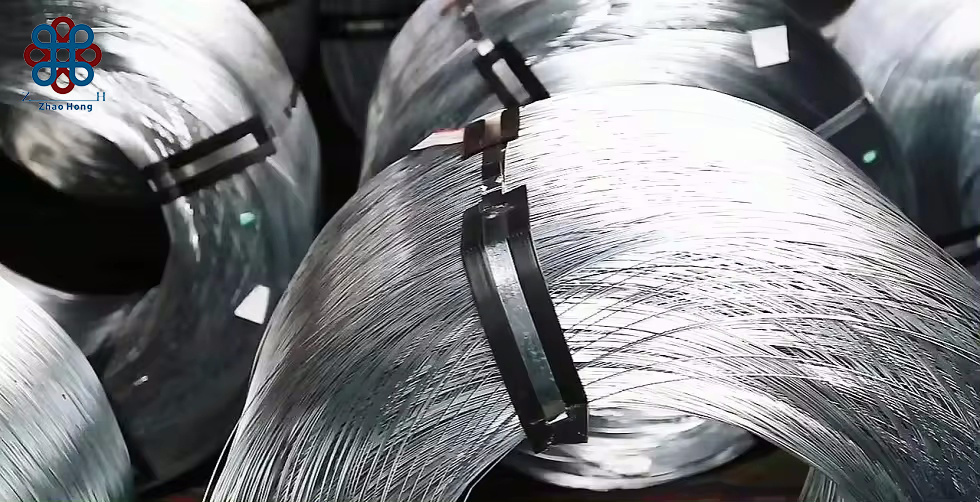
EG: Mirror bright and shiny surface, visually attractive but misleading for outdoor use.
Adhesion & Toughness
HDG: Alloy transition layer prevents peeling. Resists bending, twisting, friction and sand abrasion without zinc powder shedding.
EG: Easy to peel and powder off under bending or vibration. Poor mechanical durability.
Service Life
HDG: Long service life for outdoor, desert, coastal and high‑humidity conditions.
EG: Fast rusting outdoors, only stable in dry indoor environments.

3. Application Scenarios
Choose Hot‑Dip Galvanized Wire For:
-
Middle East desert projects, high temperature & sand abrasion areas
-
Outdoor fencing, wire mesh, solar binding, construction tying
-
Coastal salt spray and long‑term exposed structures
-
Automated mesh weaving and repeated bending processing
Choose Electro‑Galvanized Wire For:
-
Indoor packaging, handicrafts, and temporary binding
-
Dry environments with no wind, rain or strong friction
-
Short‑term low‑budget indoor applications
4. Quick On‑Site Identification Methods
Visual check: Super bright mirror surface = electro‑galvanized; matte silver grey = hot‑dip galvanized.
Bending test: Repeated bending causes zinc peeling on EG wire; HDG wire remains intact.
Coating weight test: HDG wire has much higher zinc reserve for anti‑corrosion durability.
5. Buyer Key Reminder
Bright surface does not equal good quality. Many suppliers substitute low‑cost electro‑galvanized wire to replace hot‑dip products. For outdoor, desert, solar and fencing projects, hot‑dip galvanized wire is always the reliable choice. Always specify zinc coating weight and hot‑dip process in your purchase contract to avoid quality risks and project losses.

Keywords:
More information

Contact
Phone/WhatsApp:
E-mail:
Address:
Huangtai Industrial Park, Xiaozhan Town,
Jinnan District, Tianjin, 300353, China
Follow us

Inquiry