


Galvanized Wire Selection Guide & Pitfall Avoidance For Roads With De-icing Salt Corrosion
Release time:
2026-07-09
In northern regions, massive de-icing salt is spread on highways in winter. Splashing salt water and melted snow leave chloride ions on binding wires of guardrails and slope protection nets, creating stronger corrosion than ordinary open-air environments.
In northern regions, massive de-icing salt is spread on highways in winter. Splashing salt water and melted snow leave chloride ions on binding wires of guardrails and slope protection nets, creating stronger corrosion than ordinary open-air environments. Many road projects choose cheap low-grade galvanized wire to cut costs, only to face zinc peeling and wire breakage after one or two winters. Loose guardrails and collapsed safety nets bring high annual maintenance costs and hidden traffic hazards. This article explains de-icing salt corrosion mechanism, mandatory material standards, common purchasing traps, matching wire sizes and maintenance tips.
1. Why De-icing Salt Causes Severe Corrosion On Galvanized Wire
Road de-icing salt mainly consists of sodium chloride and calcium chloride. Melted salt water triggers three severe corrosion effects that quickly destroy thin zinc coating:
- Strong penetration of chloride ions Chloride breaks the passive film on zinc surface, invades pinholes and tiny cracks inside coating, and triggers electrochemical rust on bare steel core, which ordinary thin wire cannot resist.
- Alternating dry-wet circulation accelerates coating loss Wires soak in salt water by day and freeze at night. Repeated thermal expansion and contraction crack zinc layer, expanding channels for corrosion.
- Long-term salt accumulation Salt mud stagnates at the bottom of guardrails and road base gaps, exposing wire to corrosive media all day long. Zinc consumption speed is over 3 times faster than normal outdoor conditions. Ordinary thin wire usually fails within two winters, leading to collapsed protective structures.
2. Four Mandatory Standards For De-icing Resistant Road Wire
(1) Zinc coating weight ≥300–350g/㎡, pass 72-hour full wire neutral salt spray test
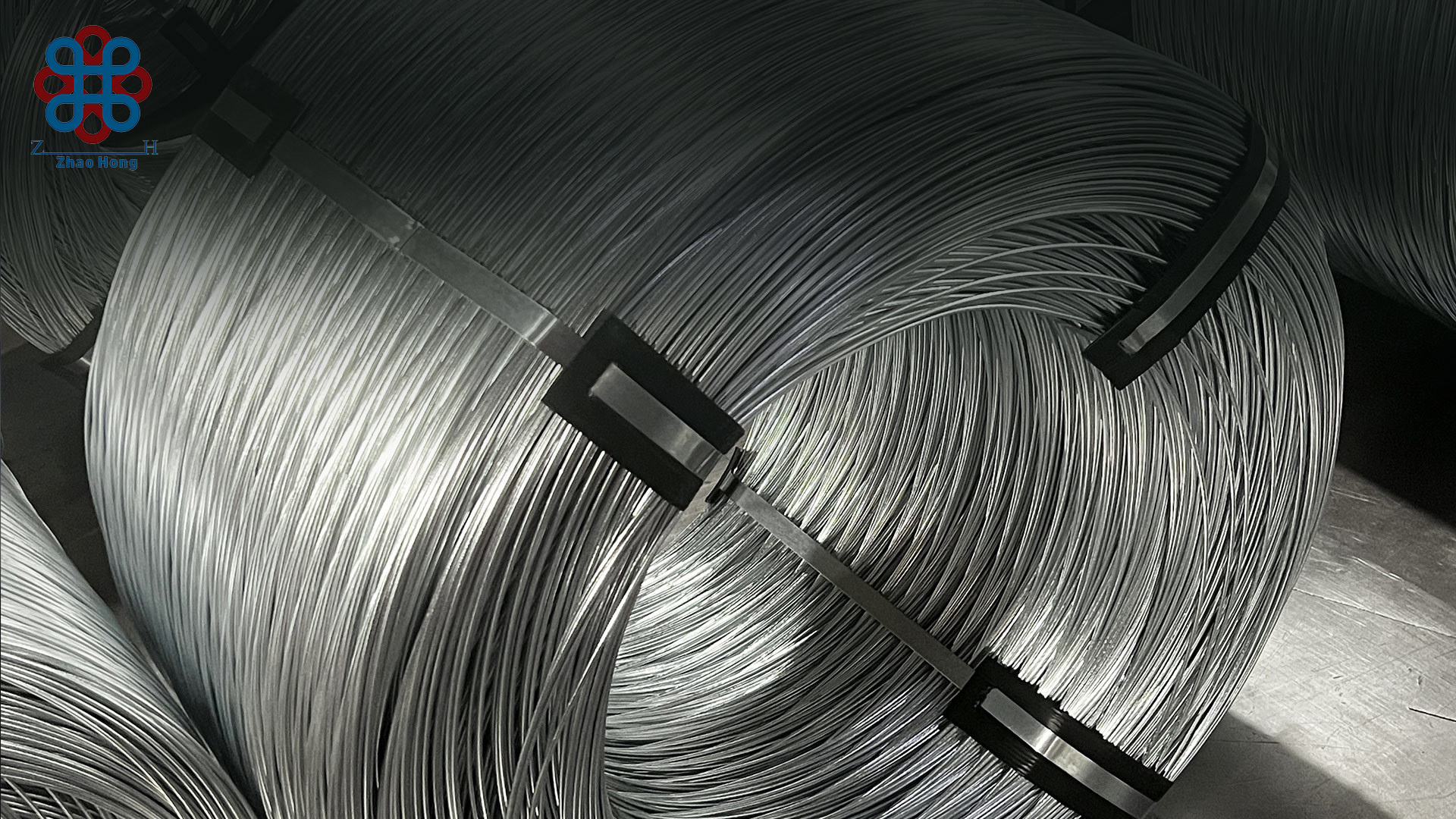
40–200g/㎡ thin coating lacks sufficient zinc reserve and wears out rapidly in salt environment. 300g+ hot-dipped high-zinc coating provides enough sacrificial zinc to resist chloride erosion through repeated winters. Request official test reports of intact finished wire; reject falsified data from polished specimens or steel plates.
(2) Complete hot-dip zinc-iron alloy process to avoid peeling under binding tension
Electro-galvanized wire and simplified hot-dipped wire have no alloy transition layer. Zinc peels off massively under twisting tension, exposing steel core to salt water instantaneously. Qualified road wire requires constant-temperature dipping at 440–460℃ to form continuous tough zinc-iron alloy layer, plus full three-stage pre-treatment (degreasing, pickling, flux drying) for maximum coating adhesion without peeling during bending and tensioning.
(3) Gradient slow cooling + passivation sealing dual protection
Low-grade wire adopts direct cold water quenching, leaving invisible microcracks inside coating for salt water penetration. Specialized road wire adds segmented slow cooling to eliminate internal stress, with extra chromate passivation forming a buffer film to slow white and red rust growth.
(4) Standard low-temperature annealing for high toughness & anti-breakage
Guardrail installation requires heavy tightening. Under-annealed rigid wire snaps easily during twisting, and broken cross-sections become vulnerable corrosion points. Fully annealed wire balances hardness and flexibility without fracture; diameter tolerance within ±0.02mm fits standard fasteners tightly to avoid salt mud accumulation gaps.
3. Matching Wire Diameter For Different Road De-icing Scenarios
- Small binding for wave guardrails & isolation nets: 1.2–1.6mm high-zinc wire
- Slope protection net & road base reinforcement: 1.8–2.5mm heavy high-zinc wire with strong tensile resistance
- Bridge guardrails & waterfront expressways (dual corrosion of salt fog & moisture): ≥2.0mm thickened high-zinc wire
4. Five Common Purchasing Traps For Road Engineering
- Only compare unit price without checking zinc weight and salt spray report Cheap thin wire saves initial cost but demands full wire replacement every winter. Labor, material and road closure expenses lead to far higher total cost and unqualified inspection results.
- Bright electro-galvanized wire disguised as road dedicated wire Shiny thin electroplated coating only suits dry indoor use. Severe black rust and zinc peeling occur after one winter of de-icing salt erosion, forbidden for outdoor road projects.
- Prioritize thick wire without verifying production technology Thick wire does not equal durable anti-rust performance. Defective pre-treatment and missing alloy layer still cause internal rapid rust penetration; thickness only affects supporting force, while coating & process decide service life.
- Suppliers provide salt spray test based on polished specimens Manufacturers grind outer zinc layer in advance to fake qualified test data. Mass-produced wire with thin porous coating fails to resist salt erosion and risks project inspection rejection.
- Wire without passivation sealing treatment No buffer film means salt adheres directly to zinc surface, generating massive white rust within months and accelerating zinc pulverization and shedding.
5. Construction & Maintenance Tips To Extend Wire Service Life
- Avoid violent bending and cutting scratches during installation; coat broken ends with anti-rust paint to block salt water invasion.
- Use plastic anti-corrosion sleeves for wire contacting damp salt mud at guardrail bottom and road base.
- High-pressure water flush accumulated salt mud every spring after de-icing season to reduce long-term salt attachment.
- Regularly inspect low-lying shaded areas; replace wires with rust spots timely to prevent rust spreading across the whole safety net.
Conclusion
Ordinary thin galvanized wire (40–200g/㎡) must not be used on permanent highways with annual de-icing salt spread. Four core selection standards: 300–350g/㎡ heavy zinc coating, qualified 72-hour salt spray test on intact wire, integrated hot-dip zinc-iron alloy technology and refined passivation & slow cooling treatment. Low-cost thin wire is only acceptable for temporary short-term fencing. For permanent guardrails and slope protection nets, de-icing resistant high-zinc galvanized wire cuts long-term maintenance cost and eliminates traffic safety hazards caused by rust failure.

Keywords:
More information


Contact
Phone/WhatsApp:
E-mail:
Address:
Huangtai Industrial Park, Xiaozhan Town,
Jinnan District, Tianjin, 300353, China
Follow us

Inquiry