


From Workmanship To Service Life: In-depth Analysis Of The Essential Differences Between Two Types Of Galvanized Wire
Release time:
2026-06-16
Galvanized wires with similar appearances vary greatly in purchase price and service life.
Galvanized wires with similar appearances vary greatly in purchase price and service life. Most buyers only notice the difference in rust resistance, ignoring the root causes. This article deeply analyzes the core essential gaps between ordinary galvanized wire and 300-350g/㎡ high zinc galvanized wire from six dimensions: raw material workmanship, production technology, coating quality, mechanical performance, environmental resistance and full-cycle service life.
1. Raw Material Workmanship: Substrate Determines Basic Performance Ceiling
Ordinary galvanized wire is made of cheap recycled mixed steel and inferior steel rod, filled with impurities, tiny pores and internal cracks. Even covered with zinc coating, moisture penetrates through substrate gaps and causes hidden internal rust. Without raw material screening procedures, hardness fluctuates wildly among wire rolls.
High zinc galvanized wire adopts national standard high-quality virgin steel rod with high purity and compact internal structure. All raw materials pass flaw detection and hardness test before production to eliminate inherent defects. Combined with thick zinc coating, dual internal and external anti-corrosion protection ensures ultra-long service life.
2. Galvanizing Process Workmanship: Huge Gap In Coating Adhesion
Ordinary galvanized wire adopts simple fast electroplating production line with short zinc dipping time and no alloy reaction. The thin zinc layer only attaches superficially at 40-200g/㎡, with uneven thickness and invisible pinholes. Coating peels off easily after slight bending or binding, once damaged, anti-rust protection fails completely.
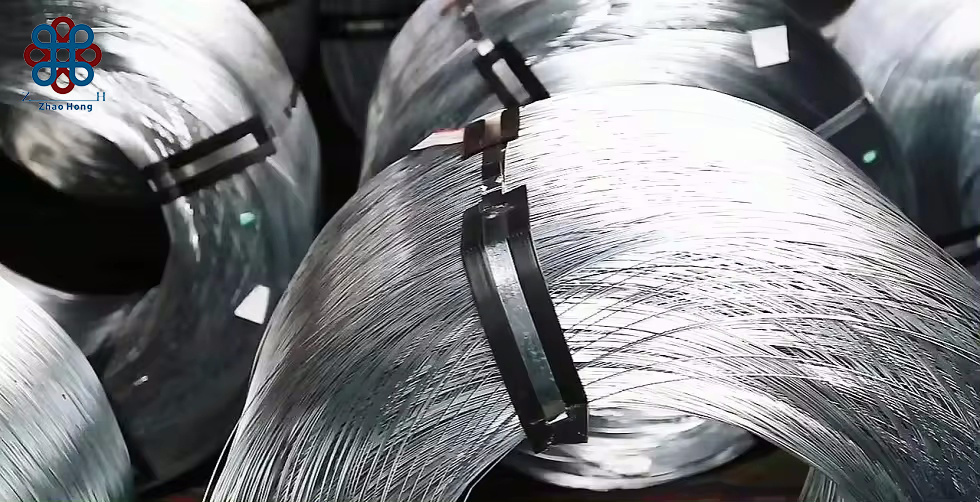
High zinc galvanized wire applies standard hot-dip galvanizing with extended dipping reaction to form a zinc-iron alloy transition layer tightly bonded to steel substrate, reaching stable 300-350g/㎡ zinc weight. Dense coating without pinholes or zinc lumps resists cracking and peeling after repeated twisting and winding, and passes 72-hour salt spray test for lasting protection.
3. Post-treatment Workmanship: Surface Finish Divides Application Scenarios
Ordinary galvanized wire skips passivation and polishing procedures, with sharp burrs and zinc lumps, plus obvious color difference between batches. It is only suitable for temporary construction with no appearance requirements, easy to scratch workers and unqualified for crafts and export precision parts.
High zinc galvanized wire supports complete dedusting, passivation and leveling post-treatment to remove burrs and excess zinc, presenting uniform bright surface without scratches. It meets demands of outdoor anti-corrosion engineering, high-end woven hardware, landscape decoration and export component processing.
4. Wire Drawing & Annealing Workmanship: Mechanical Performance Affects Construction Waste Rate
Ordinary galvanized wire adopts low-precision drawing equipment with unstable wire diameter tolerance and simplified annealing. The wire is either brittle and easy to break or too soft to support load, frequently jamming automatic weaving machines, causing massive wire waste and delayed construction.
High zinc galvanized wire uses micron-level precision drawing equipment with tolerance controlled within ±0.02mm, matched with constant low-temperature annealing to balance hardness and flexibility. It resists breakage under tension and repeated bending, reducing waste and labor cost during mass automatic production.
5. Weather Resistance Workmanship: Service Life Gap In Harsh Environments
Thin coating of ordinary galvanized wire only fits dry indoor normal temperature environments. Under coastal salt fog, high temperature exposure, frost and mild acid-base conditions, coating ages rapidly and gets rusty within 1-3 years requiring full replacement.
Thickened high zinc coating strongly blocks salt, moisture and corrosive chemicals, avoiding coating cracking caused by temperature difference. It can serve stably for 8-10 years in coastal ports, aquaculture farms, highway guardrails and chemical plants, with service life over 3 times longer than ordinary wire.
6. Full-cycle Service Life Comparison: Disposable Low-cost Material VS Long-term Durable Material
Ordinary galvanized wire only boasts low one-time purchase price, yet needs frequent replacement within short periods. Additional cost from maintenance, construction shutdown and project rectification leads to higher total investment, together with potential safety hazards from rust.
High zinc galvanized wire requires slightly higher initial investment, but stays intact for nearly a decade with almost no later maintenance or replacement expense, eliminating rework risks. It delivers far better overall cost performance in long-term engineering, outdoor projects and stable foreign trade orders.
Conclusion
The two types of galvanized wire differ far beyond zinc coating thickness, with comprehensive essential gaps covering raw materials, processing procedures, fine workmanship and service life. Ordinary wire works for short-term indoor temporary construction to control initial budget. For high-standard scenarios such as outdoor coastal projects, automatic processing and long-term engineering, 300-350g/㎡ high zinc galvanized wire brings longer service life and lower overall cost relying on complete refined workmanship.

More information


Contact
Phone/WhatsApp:
E-mail:
Address:
Huangtai Industrial Park, Xiaozhan Town,
Jinnan District, Tianjin, 300353, China
Follow us

Inquiry