


The Effect of Coating Thickness on the Performance Characteristics of Hot Dip Galvanized Wire
Release time:
2024-12-23
The primary function of the zinc coating on hot - dip galvanized wire is to prevent corrosion. A thicker zinc coating provides better protection. Zinc forms a passive layer of zinc oxides and hydroxides in the air. When the coating is thicker, this protective layer is more durable and effectively isolates the wire substrate from oxygen and moisture.
The coating thickness of hot - dip galvanized wire has a significant impact on product performance:
- Corrosion resistance
- The primary function of the zinc coating on hot - dip galvanized wire is to prevent corrosion. A thicker zinc coating provides better protection. Zinc forms a passive layer of zinc oxides and hydroxides in the air. When the coating is thicker, this protective layer is more durable and effectively isolates the wire substrate from oxygen and moisture.
- For example, in a normal outdoor environment, if the zinc coating thickness of hot - dip galvanized wire meets the thicker grade specified by national standards (about 80 - 100μm), its corrosion - resistant life in the natural environment will be much longer than that of hot - dip galvanized wire with a thinner coating (such as 30 - 40μm). In areas with acid rain or high humidity, a thick - coated hot - dip galvanized wire can better resist the erosion of acidic substances and moisture, thus prolonging the service life of the hot - dip galvanized wire.
- Mechanical properties
- Wear resistance: An appropriate thickness of the zinc coating can enhance the wear - resistance of hot - dip galvanized wire. When hot - dip galvanized wire is used to make products that require frequent friction (such as protective nets), the zinc coating can play a role in wear resistance. When the wire is subject to external friction, the zinc coating will be worn first, protecting the internal wire substrate. If the zinc coating is too thin, it may be quickly worn away, exposing the wire substrate and making it prone to damage; a moderately thick zinc coating (such as 50 - 70μm) can maintain the integrity of the hot - dip galvanized wire for a longer time.
- Tensile resistance: To some extent, the zinc coating thickness affects the tensile resistance of hot - dip galvanized wire. However, this effect is relatively complex. If the coating is too thick, the zinc coating may peel off during the stretching process, affecting the overall performance of the hot - dip galvanized wire. But within a reasonable range of coating thickness (such as not exceeding a certain proportion of the wire diameter), its impact on the tensile resistance of hot - dip galvanized wire is relatively small, and it can also enhance the toughness of the wire to some extent during stretching.
- Welding performance
- The zinc coating thickness has a significant impact on the welding performance of hot - dip galvanized wire. When the coating is thick, more zinc vapor will be generated during the welding process because zinc has a low melting point (about 419.5°C). These zinc vapors will interfere with the welding process, leading to welding defects such as porosity and slag inclusions. Therefore, for applications where hot - dip galvanized wire needs to be welded, it is usually desirable that the zinc coating thickness is not too thick, or the zinc coating should be appropriately treated (such as grinding to remove part of the coating) before welding.
- Appearance quality
- The coating thickness changes the appearance of hot - dip galvanized wire. A thicker zinc coating will make the surface of the hot - dip galvanized wire look brighter and more plump. In some applications with high appearance requirements (such as decorative wire mesh), an appropriate zinc coating thickness can improve the aesthetics of the product. However, if the coating is too thick, problems such as uneven coating and zinc nodules may occur, affecting the appearance of the hot - dip galvanized wire and subsequent processing and use.
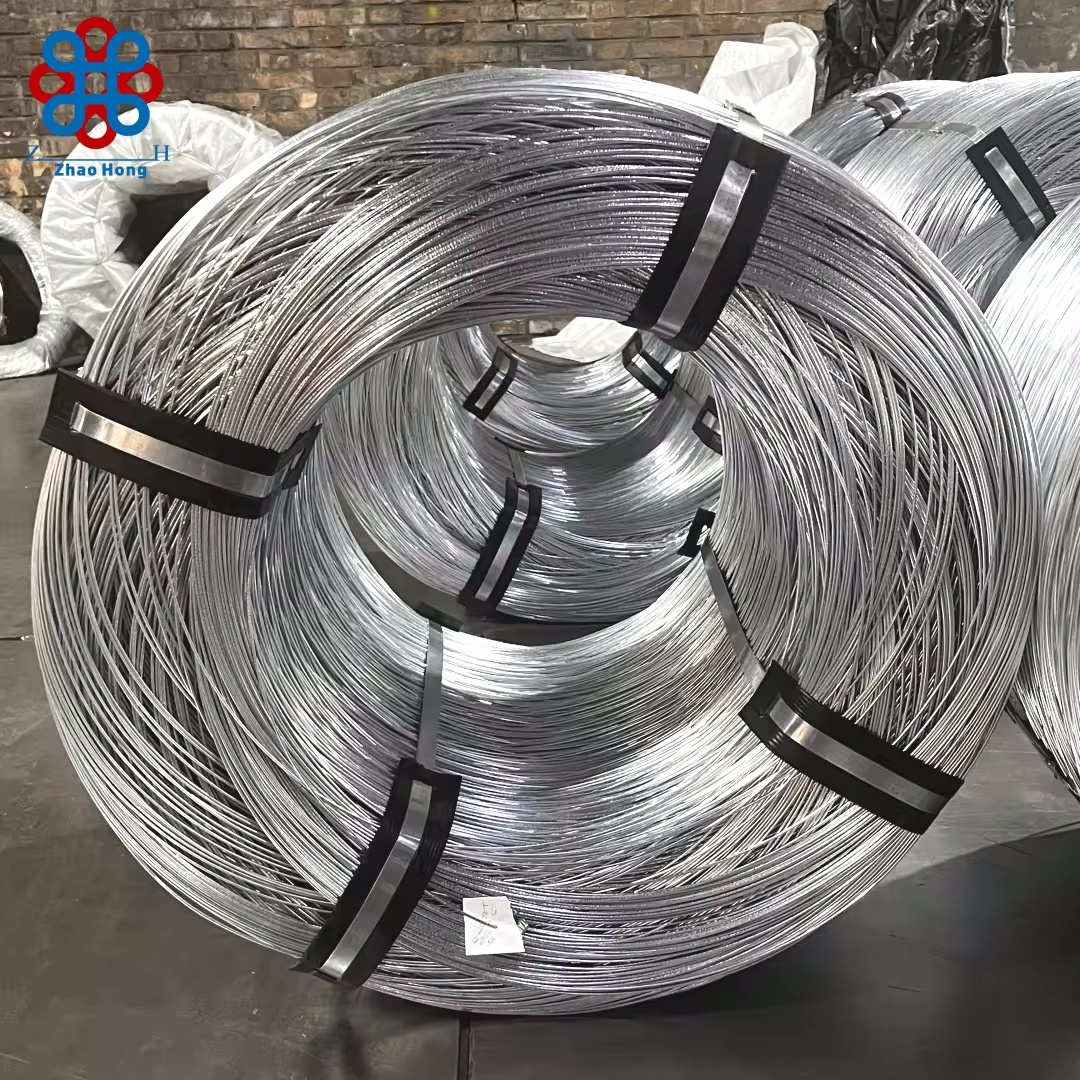
To ensure the uniform coating thickness of hot - dip galvanized wire, the following methods can be considered:
- Pre - treatment before galvanizing
- Surface cleaning:
- Before galvanizing, it is essential to ensure that the surface of the hot - dip galvanized wire is clean. Oils, rusts and other impurities on the surface will affect the adhesion and uniformity of the zinc coating. Chemical cleaning methods can be used. For example, alkaline detergents can be used to remove oils and acid - washing to remove rusts. The hot - dip galvanized wire can be immersed in a solution containing alkaline substances such as sodium hydroxide to decompose oils through chemical reactions, and then immersed in a dilute hydrochloric acid - washing solution to remove rusts.
- After cleaning, the hot - dip galvanized wire needs to be thoroughly rinsed with clean water to prevent the residual cleaning solution from affecting the galvanizing effect. At the same time, it is necessary to ensure that the surface of the rinsed hot - dip galvanized wire is dry to avoid local temperature changes or uneven chemical reactions caused by water during the galvanizing process.
- Surface pre - treatment process control:
- For some hot - dip galvanized wires with special requirements, mechanical pre - treatment such as grinding or sandblasting may be required. Grinding can make the surface of the hot - dip galvanized wire more flat and smooth, which is conducive to the uniform deposition of the zinc coating. Sandblasting can form a microscopic rough structure on the surface, increasing the adhesion between the zinc coating and the substrate. When performing these pre - treatments, it is necessary to ensure that the entire surface of the hot - dip galvanized wire is uniformly treated to avoid local over - grinding or uneven sandblasting.
- Surface cleaning:
- Control of the galvanizing process
- Control of zinc bath composition and temperature:
- The composition of the zinc bath is one of the key factors affecting the uniformity of the coating thickness. Appropriate zinc bath composition can ensure the quality and uniformity of the zinc coating. Usually, in addition to zinc, the zinc bath also contains a small amount of other elements, such as aluminum. Aluminum can improve the performance of the zinc coating and is also helpful for the uniform deposition of the zinc coating. For example, when the zinc bath contains about 0.2% aluminum, the zinc coating can be more compact and uniform.
- The temperature of the zinc bath also needs to be strictly controlled. Generally, the temperature of the zinc bath is more appropriate between 440 - 460°C. If the temperature is too high, the fluidity of the zinc bath is too strong, which may lead to an uneven zinc coating thickness during the immersion process of the hot - dip galvanized wire, with local over - thick or over - thin situations; if the temperature is too low, the viscosity of the zinc bath increases, which is not conducive to the uniform attachment of the zinc coating.
- Control of immersion time and speed:
- The immersion time of the hot - dip galvanized wire in the zinc bath has a direct impact on the coating thickness. If the immersion time is too short, the zinc coating may be too thin; if the immersion time is too long, the coating will be too thick. Generally, the appropriate immersion time is determined according to factors such as the diameter, material of the hot - dip galvanized wire and the composition of the zinc bath. For example, for hot - dip galvanized wires with a diameter of 3 - 5 mm, the immersion time may be about 30 - 60 seconds under normal zinc bath composition and temperature.
- The speed at which the hot - dip galvanized wire enters and leaves the zinc bath is also important. The speed should be uniform and stable, avoiding being too fast or too slow. If the speed is too fast, the attachment of the zinc bath on the surface of the hot - dip galvanized wire may be uneven, resulting in a wavy or locally accumulated zinc coating; if the speed is too slow, it will affect the production efficiency and may lead to an uneven coating thickness.
- Control of zinc bath composition and temperature:
- Post - treatment after galvanizing
- Control of cooling method:
- The cooling process after hot - dip galvanizing also has a certain impact on the uniformity of the coating thickness. Generally, natural cooling or air - cooling methods are used. If water - cooling is used, it should be noted that the cooling speed should not be too fast, otherwise the zinc coating may peel off or crack locally due to thermal stress, thus affecting the uniformity of the zinc coating.
- During the cooling process, it is necessary to ensure that the cooling speeds of different parts of the hot - dip galvanized wire are basically the same. For example, when using air - cooling, it is necessary to ensure that the air source blows evenly on all parts of the hot - dip galvanized wire to avoid local rapid cooling.
- Control of cooling method:

Additional Resources
-
Hot-DIP Galvanized Wire Mesh Welded Wire Mesh
-
Galvanzied Wire, Galvanized Iron Wire
-
Formability and Thickness of Hot-Dip Galvanized
- HOT-DIP GALVANIZED LAYER THICKNESS CONTROL
Keywords:
More information


Contact
Phone/WhatsApp:
E-mail:
Address:
Huangtai Industrial Park, Xiaozhan Town,
Jinnan District, Tianjin, 300353, China
Follow us

Inquiry