


Application and Specification Analysis of Galvanized Wire Drum Support
Release time:
2024-11-21
The following is an analysis of the application and specification details of drum supports made of galvanized wire:
The following is an analysis of the application and specification details of drum supports made of galvanized wire:
Application
- In the Galvanized Wire Production Line
- Support and Guide: In the production process of galvanized wire, from the unwinding of raw material wire to the final winding of the finished product, the transmission of drums is indispensable in every process. The drum support, as the supporting structure of the drum, ensures that the drum can be stably in the working position, enabling the galvanized wire to smoothly transition between different processes. For example, before the galvanized wire enters the galvanizing tank, it needs to be accurately guided by a series of guide drums. The drum support ensures the accurate and fixed position of these guide drums, preventing the wire from deviating from the predetermined galvanizing path, thus ensuring the uniformity and quality of the galvanized layer.
- Tension Adjustment Aid: Some drum supports are designed with adjustable height or angle functions, which is helpful for fine-tuning the tension of the galvanized wire during the transmission process. For example, in the winding process, if the tension is too large, it may cause deformation or damage to the galvanized wire. By adjusting the height of the drum support to change the relative position of the drum, the wrapping angle of the wire on the drum is changed, thereby affecting the wire tension and keeping it within an appropriate range to ensure the mechanical properties and surface quality of the galvanized wire.
- In Different Production Processes
- Unwinding Process: The drum support on the unwinding stand is mainly used to support the unwinding drum and ensure a smooth and uninterrupted unwinding process. The structural design needs to consider the weight and size of the unwinding drum as well as the tension control when the wire is initially unwound. Usually, a relatively solid frame structure is adopted, which has sufficient stability to prevent the wire from tangling or breaking due to vibration or imbalance during the unwinding process.
- Pretreatment Process: During the degreasing, pickling and other pretreatment processes of the galvanized wire before galvanizing, the drum support needs to adapt to the corrosive environment of the pretreatment solution. The selection of material and surface treatment of the support is crucial. Generally, stainless steel with good corrosion resistance or carbon steel with special anti-corrosion coating is used. At the same time, the layout of the drum support should be designed according to the shape and process requirements of the pretreatment tank to ensure that the wire can be fully immersed in the solution for treatment and can be smoothly guided by the corresponding drums when transitioning from one treatment tank to another, reducing the friction between the wire and the tank wall or other components.
- Galvanizing Process: The drum support around the galvanizing tank is exposed to a harsh environment of high temperature and zinc liquid splashing. The support not only needs to have high temperature resistance but also needs to prevent the zinc liquid from adhering and affecting its structure and function. Usually, heat-resistant alloy materials are used or common materials are treated with high temperature resistant coatings. Moreover, in terms of structure, reasonable protective baffles should be designed to avoid the direct splashing of zinc liquid onto key supporting parts and bearings. At the same time, in order to ensure the accurate immersion time and angle of the galvanized wire in the zinc liquid, the position accuracy of the drum support is required to be high, so as to accurately control the position and speed of the wire entering and leaving the zinc liquid.
- Winding Process: The drum support in the winding area is mainly used to cooperate with the winding machine to complete the neat winding of the galvanized wire. The design of the support needs to consider the winding speed, wire tension and winding uniformity requirements. For example, a drum support with a tension feedback adjustment device can monitor the tension change of the wire in real time and automatically adjust the position or angle of the drum on the support to ensure a constant tension during the winding process, so that the galvanized wire is evenly and tightly wound on the winding reel, improving the winding quality and appearance of the finished product.
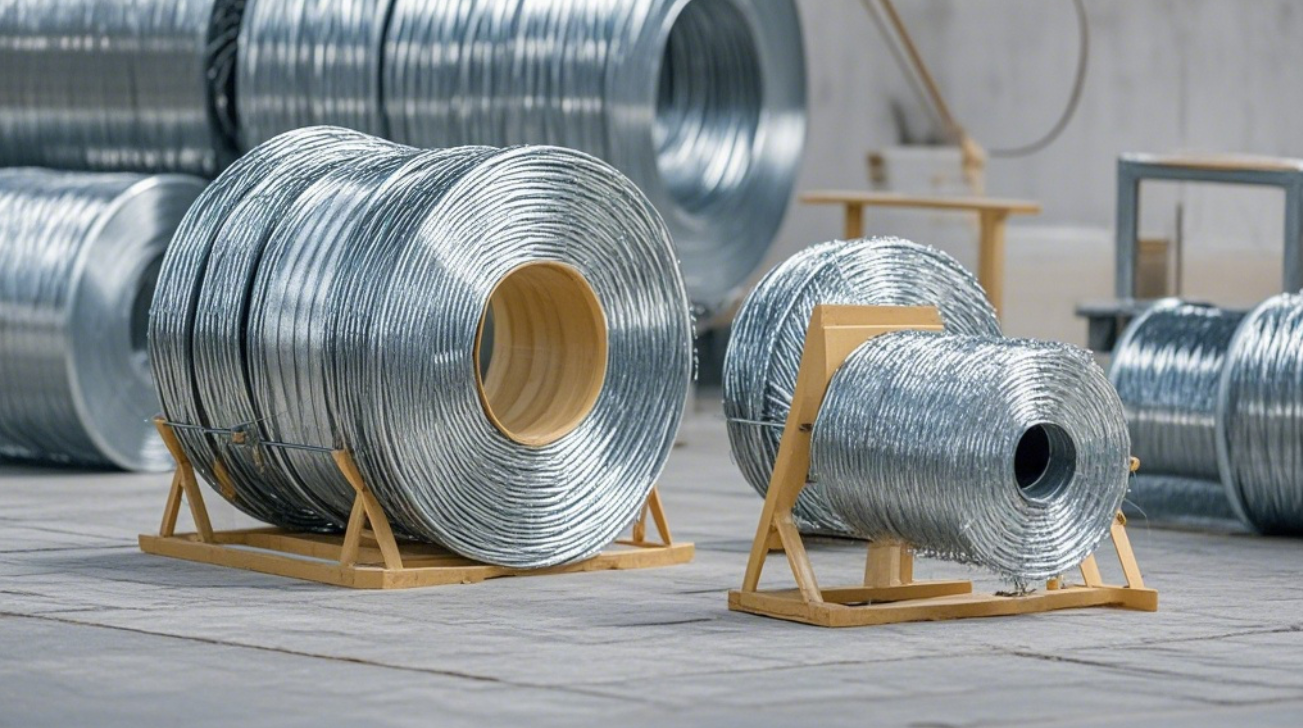
Specification Details
-
Structural Design
-
Frame Type
-
Cantilever Structure: It is suitable for situations where space is limited or the unilateral force is small. It is characterized by being fixed at one end on the supporting foundation and the other end being suspended for installing the drum. This structure is simple and compact, and easy to install, but its load-bearing capacity is relatively weak. It is generally used to support lighter drums in small galvanized wire production lines, such as for the initial path adjustment of galvanized wires with small diameters and low tensions in some small wire drawing machines.
-
Gantry Structure: It consists of two columns and a crossbeam to form a gantry-like shape. This structure has high stability and load-bearing capacity and can withstand large vertical and horizontal loads. In key processes of large galvanized wire production lines, such as the wire transmission before and after the galvanizing tank, when it is necessary to support heavier drums and ensure the stability of the wire during high-speed and high-tension transmission, the gantry-type drum support is often used. The columns and crossbeams are generally made of steel with larger cross-sectional dimensions, and the connection parts are reinforced, such as by welding reinforcing ribs, to improve the rigidity of the overall structure.
-
Frame Structure: It is a more general multi-drum supporting structure, composed of multiple crossbeams and longitudinal beams to form a rectangular or square frame. This structure can flexibly install multiple drums and is suitable for complex wire transmission paths and production scenarios where multiple processes work together. For example, in some highly automated galvanized wire production lines, from raw material pretreatment to galvanizing and then to post-treatment, the frame-type drum support may be used to uniformly layout and support drums with different functions, facilitating the overall design and maintenance of the production line. The strength and stability of the frame structure depend on the cross-sectional size, material selection and connection method of the beam. Usually, bolt connection or welding connection is used, and detailed mechanical calculation and simulation analysis should be carried out during the design to ensure that the load-bearing requirements can be met under various working conditions.
-
-
Connection Method
-
Welding Connection: Welding is one of the commonly used connection methods in the manufacture of drum supports. For some fixed structures or parts with high requirements for overall rigidity, such as the connection between the columns and crossbeams of the gantry support and the corner connection of the frame support, welding can achieve a firm connection. After welding, the structure needs to be stress relieved to prevent deformation or cracking caused by welding residual stress. For example, after welding a carbon steel drum support, annealing treatment is generally required to eliminate welding stress and improve the stability and reliability of the structure.
-
Bolt Connection: Bolt connection has the advantages of being detachable, easy to repair and adjust. In some parts that need to frequently replace drums or make local adjustments to the support structure, such as the connection between the crossbeam and the longitudinal beam of the frame support and the installation part of the drum and the support, bolt connection is often used. The specification and strength grade of the bolts should be selected according to the load-bearing requirements of the support and the force situation of the connection part. During installation, the bolts should be tightened according to the specified torque to ensure the reliability of the connection. At the same time, in order to prevent the bolts from loosening in a vibrating environment, anti-loose nuts or spring washers and other anti-loose measures are generally used.
-
-
-
Material Selection
-
Carbon Steel Material: Carbon steel is one of the commonly used materials for making drum supports, with the advantages of low cost and high strength. Generally, carbon structural steels such as Q235 and Q345 are used. Q235 carbon steel has good welding performance and a certain strength, and is suitable for making drum supports under general working conditions, such as in some parts of small galvanized wire production lines where the environmental requirements are not high and the force is small. Q345 carbon steel has higher strength, with a yield strength of up to 345MPa, and can withstand larger loads. It is often used for drum supports with certain load-bearing requirements in medium-sized galvanized wire production lines, such as some supporting structures near the galvanizing tank. However, the corrosion resistance of carbon steel material is poor, and it is prone to rust in a humid or corrosive medium environment. Therefore, when using carbon steel to make drum supports, surface treatment such as painting and galvanizing is required to improve its corrosion resistance.
-
Stainless Steel Material: Stainless steel has excellent corrosion resistance and is suitable for processes with corrosive environments in the production of galvanized wire, such as the pretreatment process and the wire transmission area in a humid environment. Commonly used stainless steel materials include 304 and 316 stainless steel. 304 stainless steel contains 18% chromium and 8% nickel, has good corrosion resistance and processing performance, and can resist general acid and alkali corrosion, showing good stability in most galvanized wire pretreatment solution environments. 316 stainless steel adds molybdenum on the basis of 304 stainless steel, further improving its corrosion resistance, especially suitable for environments containing strong corrosive media such as chloride ions, such as in the production of drum supports in some pretreatment processes near the seaside or using chlorine-containing additives. Although the cost of stainless steel material is relatively high, its good corrosion resistance and long service life make it widely used in galvanized wire production lines with high requirements for product quality and equipment reliability.
-
-
Dimension Parameters
-
Drum Installation Dimensions
-
The design of the drum support should accurately match the size of the drum. First, the diameter of the drum needs to be adapted. Different specifications of galvanized wire production lines may use drums with different diameters, generally ranging from 200mm to 800mm. The dimensions of the shaft seat and the clamping groove of the drum support should be designed according to the shaft diameter and the shape of the drum to ensure that the drum can be accurately installed on the support and will not have axial or radial displacement during high-speed rotation. For example, for a drum with a shaft diameter of 50mm, the inner diameter of the shaft seat of the support is generally designed with a tolerance range of 50mm + 0.1mm - 0.2mm, which can not only ensure the convenience of drum installation but also ensure its fitting accuracy.
-
The center distance of the drums is also a key dimensional parameter. In the galvanized wire production line, the center distance of the drums between different processes needs to be determined according to the wire transmission requirements and process characteristics. Generally, in the wire drawing process, in order to achieve accurate wire drawing multiple control, the center distance of adjacent drums may be smaller, ranging from 500mm to 1000mm; while in the wire guiding process before and after the galvanizing tank, the center distance may be larger, ranging from 1000mm to 2000mm, to ensure that the wire has enough space for immersion and cooling in the galvanizing tank. The length of the crossbeam and the position of the mounting holes of the drum support should be designed according to the requirements of the center distance of the drums, and the consistency of the center distance between multiple supports should be ensured. Usually, the tolerance of the center distance is controlled within ±1mm - ±2mm.
-
-
Overall Support Dimensions
-
The overall height, width and length of the drum support should be designed according to the layout and space limitations of the production line. In some factories with limited space, it is necessary to design a compact drum support structure, while ensuring that operators have enough space for equipment maintenance and wire threading operations. For example, in a small galvanized wire workshop, the height of the drum support is generally controlled between 1.5m and 2.5m, the width is between 0.5m and 1.5m according to the number and arrangement of drums, and the length is determined according to the length of the production line and process requirements, which may be between 3m and 10m. In large automated galvanized wire production lines, due to the large scale of the equipment, the size of the drum support also increases correspondingly. The height may reach 3m to 5m, the width is 2m to 3m, and the length can be dozens of meters or even longer. Moreover, when designing, the overall structural stability and the convenience of transportation and installation should be considered. It may be designed in sections and assembled on site.
-
-
-
Surface Treatment
-
Painting Treatment: For drum supports made of carbon steel, painting is a common surface treatment method. First, the surface of the support needs to be derusted and degreased. Generally, sandblasting or chemical derusting methods are used to remove rust and oil stains on the surface, and then primer and finish paint are sprayed. The primer is used to enhance the adhesion of the coating to the metal surface. Commonly used primers include epoxy primers. The finish paint mainly plays a role of decoration and protection. Different colors and performance finish paints can be selected according to different use environments. For example, alkyd finish paint can be used in general indoor environments, while acrylic finish paint or polyurethane finish paint can be used in outdoor environments with certain weather resistance requirements. The painted drum support can improve its corrosion resistance and appearance quality to a certain extent, and the color can be matched according to the overall color tone of the production line to make the equipment look more beautiful and unified.
-
Galvanizing Treatment: Hot-dip galvanizing treatment of drum supports is a more effective anti-corrosion method. Hot-dip galvanizing is to immerse the pretreated support in high-temperature zinc liquid to form a zinc-iron alloy layer and a pure zinc layer on the surface of the support. This zinc layer can effectively isolate air and moisture and prevent the support from rusting. The drum support after hot-dip galvanizing treatment has good corrosion resistance, especially suitable for galvanized wire production lines outdoors or in humid environments. In some coastal areas or factories with high requirements for equipment corrosion protection, hot-dip galvanized drum supports are widely used. The thickness of the hot-dip galvanized layer is generally between 60μm and 120μm. The greater the thickness, the better the anti-corrosion performance, but the cost will also increase accordingly. When performing hot-dip galvanizing treatment, it is necessary to pay attention to protecting the threaded holes, shaft seats and other parts of the support to prevent the zinc liquid from clogging or affecting its dimensional accuracy. Thread protection sleeves, fusible material plugging and other methods can be used for protection.
-
Passivation Treatment: Sometimes, the drum support after painting or galvanizing treatment also needs to be passivated. Passivation treatment is to form a passivation film on the surface of the support to further improve its corrosion resistance and anti-pollution ability. For the painted support, the passivation film can enhance the durability of the finish paint and prevent the finish paint from premature aging and peeling under the action of ultraviolet rays, acids and alkalis. For the galvanized support, the passivation film can make the zinc layer more stable and reduce the formation of white rust on the zinc layer in a humid environment. Passivation treatment generally adopts chromate passivation or chromium-free passivation process. Although the chromate passivation treatment has a better effect, due to the environmental harm of chromium ions, the chromium-free passivation process has gradually attracted attention and been applied in recent years. The chromium-free passivating agent mainly uses organic resins, molybdates, tungstates and other components, and can form a colorless, transparent or slightly colored passivation film on the surface of the support, which has good environmental protection performance and a certain corrosion resistance.
-

Additional Reosources
-
High Quality Galvanized Steel Electro Galvanized Wire
-
Galvanized Steel Wire Conductor for ACSR Supply
-
DRUM | definition in the Cambridge English Dictionary
-
Professional Manufacturer of Galvanized Steel Wire
Keywords:
More information


Contact
Phone/WhatsApp:
E-mail:
Address:
Huangtai Industrial Park, Xiaozhan Town,
Jinnan District, Tianjin, 300353, China
Follow us

Inquiry