


Specific Analysis of the Weight Calculation Method of Barbed Wire
Release time:
2024-08-09
The weight calculation of barbed wire mainly depends on its wire diameter, material density, and total length.
The weight calculation of barbed wire mainly depends on its wire diameter, material density, and total length.
The basic formula for calculating the weight of barbed wire is: Weight (W) = π × (Wire Diameter/2)^2 × Length × Density
Here's a detailed breakdown:
- Wire Diameter: Measured in millimeters (mm) or other linear units, it represents the thickness of the wire used in the barbed wire.
- Length: Measured in meters (m) or the same linear unit as the wire diameter. It indicates the total length of the barbed wire.
- Density: The density of the material from which the barbed wire is made. Common materials for barbed wire include galvanized steel, and the density of steel is approximately 7850 kilograms per cubic meter.
For example, if the wire diameter of the barbed wire is 2.0 mm (converted to meters as 0.002 m), the length is 100 m, and the density is 7850 kg/m³:
First, calculate the cross-sectional area of the wire:
Area = π × (0.002/2)^2 ≈ 3.14 × 10^(-6) square meters
Then calculate the weight:
Weight = 3.14 × 10^(-6) × 100 × 7850 ≈ 2.465 kg
It should be noted that this is a simplified calculation and actual weights may vary slightly due to factors such as the shape and arrangement of the barbs.
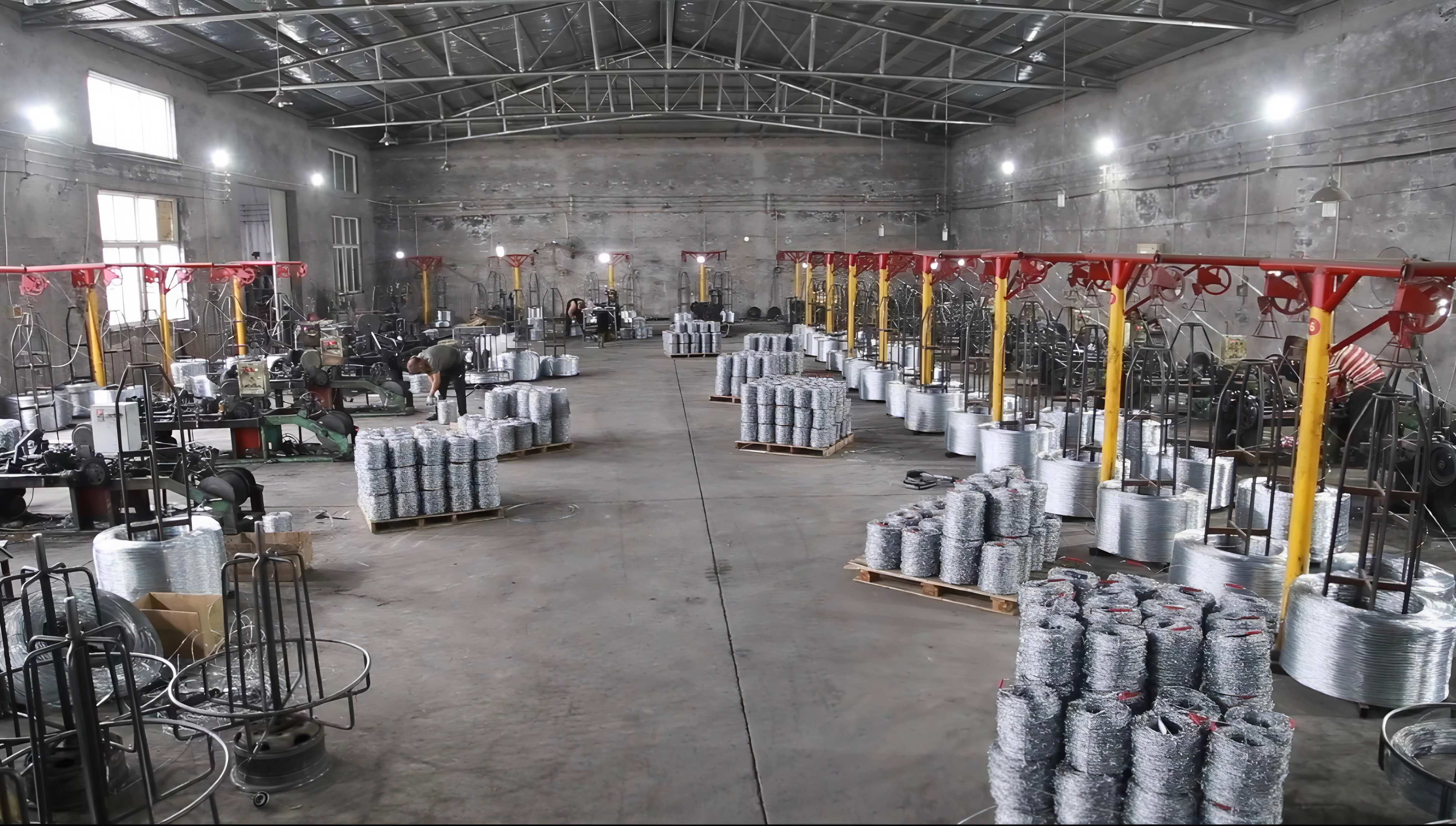
Barbed wire diameter and weight standards can vary depending on several factors, including the intended application, industry standards, and local regulations. Here's a specific analysis:
Wire Diameter:
- Common barbed wire diameters range from approximately 1.6mm to 2.8mm. A smaller diameter like 1.6mm might be used in less demanding security or fencing applications, such as for marking boundaries or in low-risk areas.
- A diameter of around 2.0mm to 2.2mm is often chosen for general-purpose fencing, such as in agricultural fields or industrial sites.
- Larger diameters, like 2.5mm or 2.8mm, are typically used in high-security areas, military installations, or where greater strength and durability are required.
Weight Standards:
- The weight of barbed wire is closely related to its diameter and the length of the wire. The weight per unit length (e.g., per meter) increases as the diameter of the wire increases.
- For example, a barbed wire with a diameter of 1.8mm might weigh approximately 0.12 kilograms per meter, while one with a diameter of 2.5mm could weigh around 0.2 kilograms per meter.
- The weight also depends on the material of the wire. Galvanized steel barbed wire of the same diameter may weigh slightly differently from stainless steel or other alloyed versions.
It's important to note that specific standards can vary by country and region, and different manufacturers may have their own specifications within a certain range. When choosing barbed wire, it's crucial to consider the specific security and fencing requirements of the application to ensure the appropriate diameter and weight are selected.

Additional Resources
- WEIGHT AND LENGTH OF BARBED WIRE
-
How To Calculate The Cost Of Barbed Wire For A Fence?
-
Commonly Used Wire for Agricultural Fences
-
Barbed Wire Weight Calculator
Keywords:
More information


Contact
Phone/WhatsApp:
E-mail:
Address:
Huangtai Industrial Park, Xiaozhan Town,
Jinnan District, Tianjin, 300353, China
Follow us

Inquiry